
The Fiction Author's
Shopify Quick-Start
Handbook
Stop giving Amazon your margin. Start owning your readers.

Before You Read This
Let me be blunt: you've probably already Googled 'how to start a Shopify store' and found a wall of generic ecommerce advice built for someone selling yoga mats or phone cases.
That advice is not wrong. It's just not for you.
You're a fiction author. Your product is a world people fall in love with. Your best customers are not just buyers — they're superfans who will buy everything you ever create, if you give them the chance.
This handbook is built specifically for that reality. It will walk you through the essentials of launching your Shopify store without burying you in tech overwhelm — and it will do it in the context of what you're actually selling: books, digital products, and merch rooted in a fictional universe.
You don't need to figure all of this out in one sitting. But you do need to start. Every day your store isn't running is a day you're handing your margin to Amazon.
Let's fix that.
— Leah McHenry, Founder, Fiction Empire
- 01You're Not a Regular Ecom Seller
- 02Shopify: The Basics
- 03Your Theme
- 04What You're Selling
- 05The Pages Your Store Needs
- 06The Author-Specific Essentials
- 07Your Launch Checklist
- 08What Comes Next
You're Not a Regular Ecom Seller
And your store shouldn't look like one.
Most Shopify guides treat the store as the product. For fiction authors, the store is the portal.
Your readers don't just want something to buy. They want more of your world. They have formed real emotional memories inside your stories. Your job is to give them a place where those feelings get to exist off the page.
This changes everything — from how your homepage looks, to what you sell, to how you write your product descriptions.
What Makes a Fiction Author Store Different
- •Product is the brand
- •Acquisition-focused: new customers
- •Description = specs and features
- •Homepage = hero image + bestseller
- •Sells one category of product
- •Low emotional connection to product
- •Marketing is transactional
- •Author is the brand; world is the brand
- •Superfan-focused: depth over breadth
- •Description = immersion and emotion
- •Homepage = entering a world
- •Books + digital + merch from same universe
- •Deep emotional investment already exists
- •Marketing is community and identity
Shopify: The Basics
What you need to know to get started.
Shopify is the platform. Not Wix. Not Squarespace. Not WooCommerce. Shopify is built specifically for ecommerce — it's optimized for selling, for AI indexing, and for scale. When your store takes off, you won't have to migrate to a better platform. You're already on it.
Choosing Your Plan
Start with the Basic plan. At the time of writing, it runs $39/month (Shopify frequently offers promotional rates, so check their site for the current pricing).
The Basic plan gives you everything you need to launch and grow: unlimited products, 2 staff accounts, discount codes, free SSL certificate, and access to the Shopify App Store.
Setting Up Your Account
Go to shopify.pxf.io/leah to start your free trial (Leah's affiliate link — the trial is the same, it just helps support Fiction Empire). You'll need:
- 1Your author name or pen name (this becomes your store name)
- 2An email address (use your author email, not a personal Gmail)
- 3A password
- 4Your country/region and currency
- 5A payment method to activate your plan after the trial ends
During setup, Shopify will ask what you're selling. Choose 'Online Store' and describe your products as books / physical goods / digital products. Don't overthink this — it just helps Shopify populate suggestions.
Your Domain Name
Your Shopify store comes with a free myshopify.com subdomain (e.g., yourname.myshopify.com). Do not use this as your permanent URL.
Purchase a custom domain. Ideally, it's your author name: yourname.com. You can buy it directly through Shopify or through a registrar like Namecheap or Google Domains and connect it. A custom domain looks professional and makes your store easier to find.
Payments: Getting Paid
Enable Shopify Payments (available in most countries). This is Shopify's built-in payment processor and it eliminates the extra transaction fee they charge when you use a third-party processor.
You'll need to verify your identity and bank account details. This takes a day or two. Don't skip it — you can't receive payouts until it's done.
Also enable PayPal as a secondary option. A segment of your readers will prefer it, and removing friction from checkout means more completed purchases.
Your Theme
The first impression that either sells or loses the reader.
Your theme is the visual design of your entire store. It controls the layout, the fonts, the way products are displayed, the mobile experience — all of it. This is not a place to be cheap.
Yes, Shopify has free themes. They work. But here's the truth:
"Free themes look like free themes. Your reader will feel the difference before they can name it."
A paid theme communicates that you are a professional. It communicates that you take this seriously. That matters to your superfans, and it matters to new readers deciding whether to trust you with their credit card number.
A paid theme is usually a one-time purchase between $180–$350. It is one of the highest-ROI investments you will make in your store.
The Free Tier: If You're Truly Starting from Zero
If budget is a real constraint right now, the free theme 'Dawn' is Shopify's cleanest option. It's minimal, loads fast, and won't embarrass you. But plan to upgrade as soon as you can.
Paid Theme Recommendations for Fiction Authors
These themes are built for visually immersive, brand-forward stores — which is exactly what you need:
1. Prestige — by Maestrooo
Available on the Shopify Theme Store. Built for premium brands with strong visual identity. Excellent editorial-style homepage layouts that work beautifully for authors. Strong full-bleed imagery support so your book covers and world art take center stage. Around $350.
2. Broadcast — by Invisible Themes
Available on the Shopify Theme Store. Cinematic, story-forward design. Strong hero sections, excellent collection page layouts, and great support for text-heavy pages (which authors need for series descriptions and world-building). Around $350.
3. Eurus — by TrioCommerce
Available on the Shopify Theme Store. Excellent for stores that blend physical products (signed books, merch) with digital (ebooks, audiobooks). Clean, fast, and highly customizable without touching code. Around $280.
The Ted Dekker Standard: What Premium Looks Like
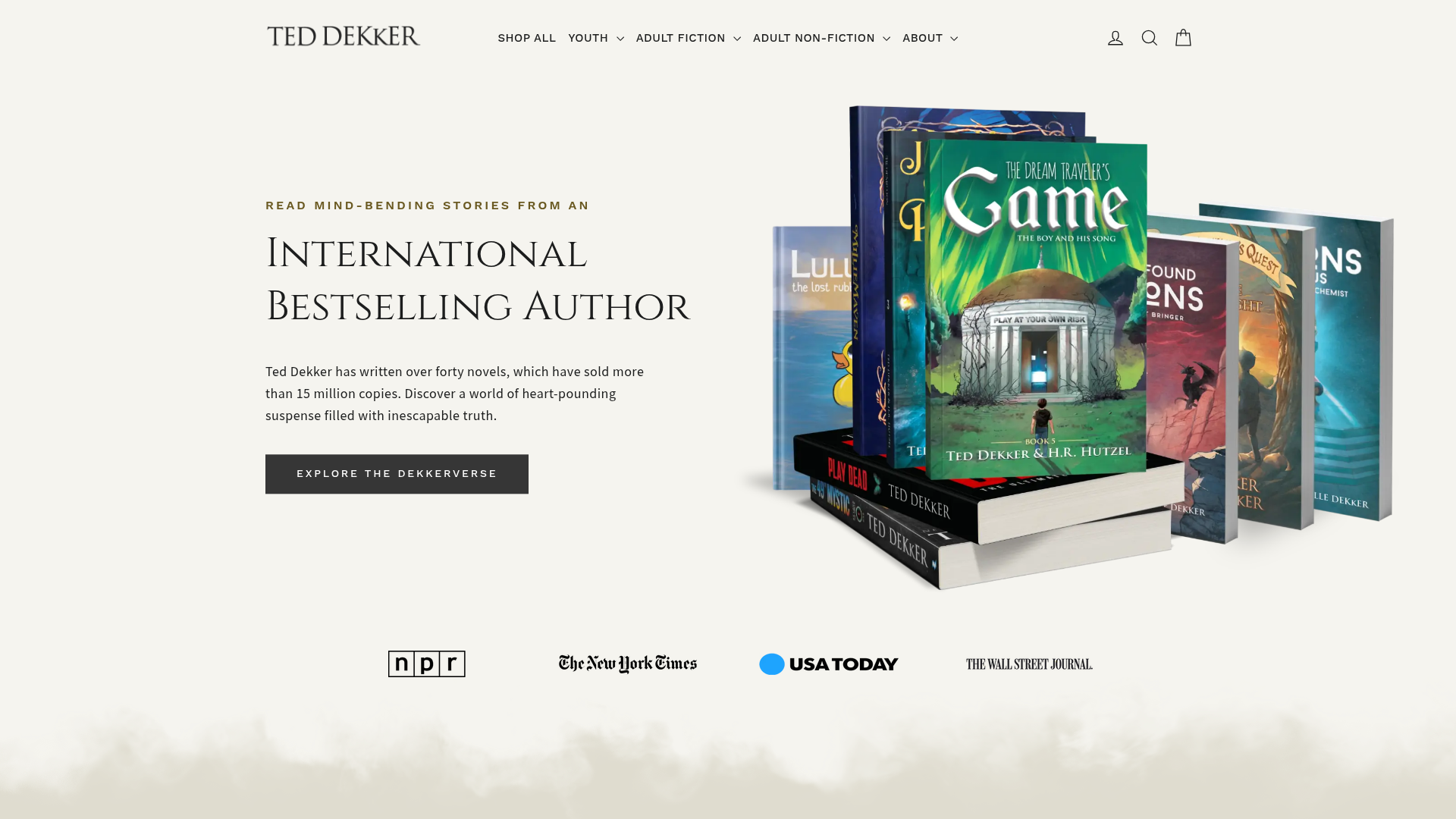
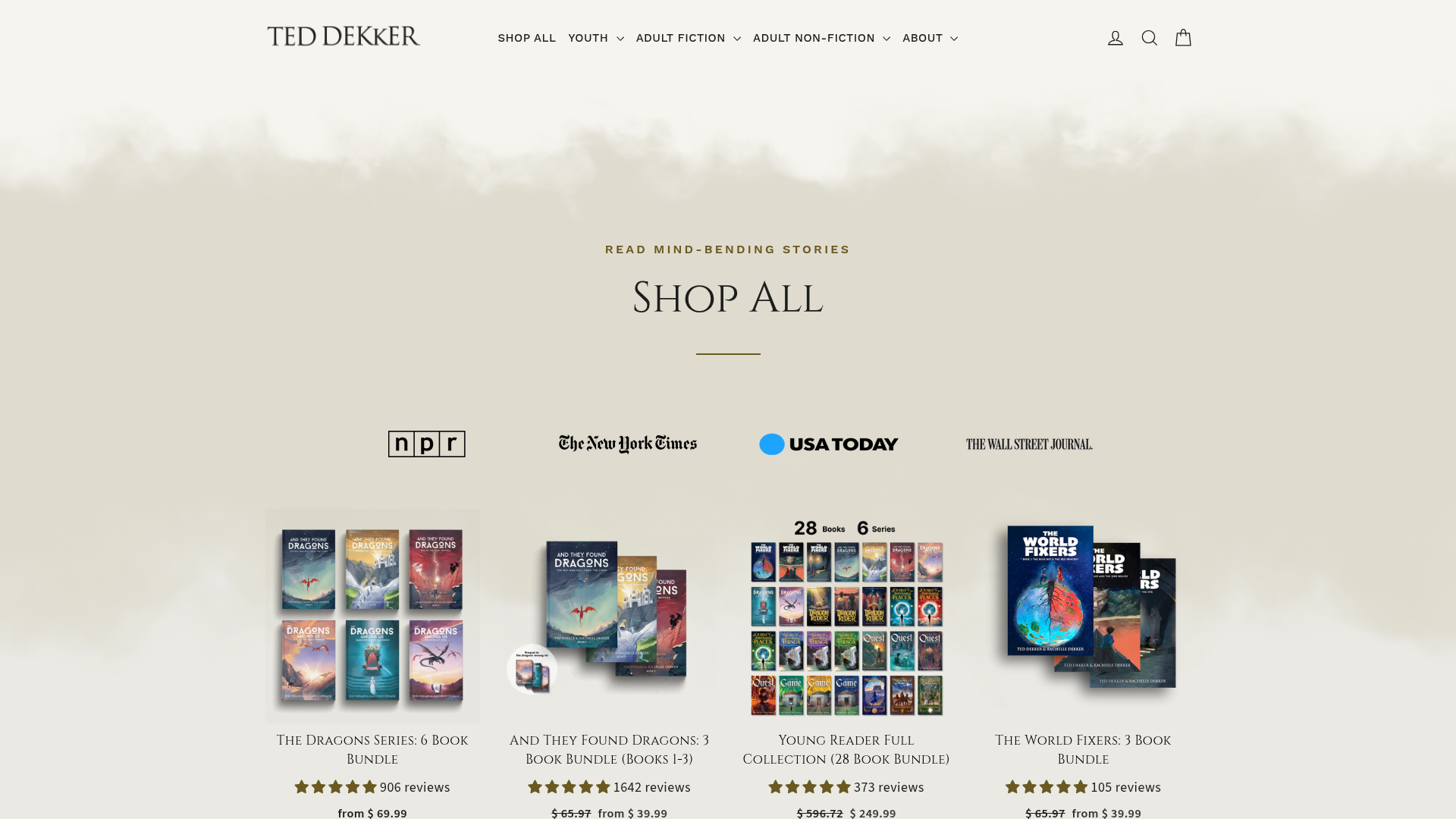
Ted Dekker is one of the best examples of a fiction author running a high-converting, immersive Shopify store. Visit his site at teddekker.com and pay attention to:
- 1The homepage hero — full-bleed, cinematic, immediately communicates the tone of his world
- 2The navigation — clean, with clear paths to books, bundles, and signed editions
- 3Product pages — the description doesn't just describe; it sells the experience
- 4The brand consistency — color palette, fonts, and copy all feel like they belong to the same world
- 5The signed edition positioning — premium product, premium presentation, premium price
This is the bar you're aiming for. You don't have to hit it on day one. But you should know what you're building toward.
What You're Selling
Books, digital products, and merch — how to set them up right.
Your store is not a single-product store. You are building an ecosystem of products that all connect back to your world. Here is how to think about each category.
Physical Books
This is the anchor of your store. Signed editions, special editions, limited-run hardcovers — these are what your superfans will pay a premium for, because they can't get them on Amazon.
- ❖Signed editions: Your signature makes a book an artifact. Price them accordingly — $5 to $15 above the retail cover price is standard.
- ❖Series bundles: Bundle a complete series at a slight discount. Increases average order value significantly. Works especially well as an upsell at checkout.
- ❖Reader boxes: Curated physical boxes with a signed book + merch items. High perceived value, high margin when done right.
Digital Products: Ebooks and Audiobooks
Selling digital products direct is one of the highest-margin moves you can make. No printing costs. No shipping. No Amazon taking 30–65% of your cover price.
To sell digital files on Shopify, you'll need a free or low-cost app. The best options for authors:
- ❖Sky Pilot — purpose-built for digital downloads including ebooks and audiobooks. Free plan available, paid plan is $9/month and worth it.
- ❖Payhip or BookFunnel — alternative delivery options if you prefer to link out to a delivery platform from your Shopify store.
Price your ebooks at $9.99–$14.99 for a standard novel direct. For special editions with bonus content — deleted scenes, author notes, extended epilogues, alternate POV chapters — price at $14.99–$19.99. Do not race to the bottom.
Readers who shop your store are not price-shopping. They came to you specifically. That buyer behavior justifies a premium over what you list on Amazon, and a few positioning moves make it feel natural:
- ❖Bundle digital + physical: A signed hardcover + ebook combo at $34.99 makes the standalone ebook at $12.99 feel like a bargain by comparison.
- ❖Name the exclusivity: 'Direct edition includes a bonus chapter not available anywhere else' gives the reader a reason the price is higher than Kindle.
- ❖Series ebook bundles: Individual book at $12.99, full series bundle at $39.99 (vs. $64.95 if bought separately). The discount creates perceived value while your per-unit margin stays strong.
For audiobooks, the same logic applies. Host the files and deliver via Sky Pilot or link to a player. Your margin on a direct audiobook sale vs. an Audible sale is dramatic.
Merch: Artifacts from Your World
Merch is where the real magic happens. This is where your readers stop being customers and start being fans who wear your world.
The best merch is specific, not generic. A hoodie that says 'READER' is forgettable. A hoodie with the motto of your protagonist's kingdom, or the coordinates of your fictional city — that's something your readers lose their minds over.
What works for fiction authors
- ❖Candles named after characters or settings (fragrance = mood of your world)
- ❖Apparel with in-world slogans, house crests, or character quotes
- ❖Jewelry or accessories that reference a pivotal scene or object from your books
- ❖Art prints of your world's maps, characters, or key locations
- ❖Sticker packs and bookmarks — low price point, great for first orders that build loyalty
You don't need to launch with all of this. Start with one or two merch items and expand as you learn what your readers respond to.
The Pages Your Store Needs
Don't skip these. Each one does a job.
A Shopify store is not just a product grid. The pages you build around your products are what convert a visitor into a buyer — and a buyer into a superfan.
1. Your Homepage
This is the first impression. It should answer one question in the first five seconds: 'Is this my kind of world?'
Lead with a full-width hero image — your best book cover art, your most atmospheric world imagery. Your tagline should be short and evocative, not a marketing slogan. Below the hero, feature your most important products and a brief intro to who you are as an author.
Do not clutter the homepage with everything. Guide the visitor. Give them one clear next step.
2. Series / Collection Pages
Organize your products by series, not just by product type. A reader who loved Book 1 of your series should be able to find every product tied to that world in one place — the ebook, the hardcover, the merch, the audiobook.
Use Shopify Collections to build this. Create a collection for each series. Name it after the series. Write a collection description that sounds like a world introduction, not a catalog index.
3. Your About Page
This page has one job: make the reader trust you enough to buy from you directly instead of Amazon. Tell your story as an author. Why do you write what you write? What does this world mean to you? Be human. Be specific. A great about page reads like the first page of a great book — it makes you want to know what comes next. Include a high-quality photo of yourself. Readers want to know who they're buying from.
4. A Dedicated 'Shop Direct' Page
Optional but powerful. Consider a page that explicitly addresses why buying from your store matters — to you and to them.
Explain that buying direct means you get more margin to keep writing, that they get exclusive products they can't find elsewhere, and that it helps a real person instead of a corporation.
This page makes the act of buying from you feel like a mission, not just a transaction.
5. FAQ / Contact
A simple FAQ covering shipping times, return policy, digital delivery, and signed edition details will eliminate a large percentage of customer service emails before they happen. Build this early.
The Author-Specific Essentials
What other ecom sellers don't need — but you do.
Email Capture: Your Most Important Asset
The day Amazon changes its algorithm, your KU income can drop overnight. The day your Instagram account gets shadowbanned, your reach disappears. Your email list can't be taken from you.
Every visitor to your Shopify store should have a reason to give you their email before they leave — even if they don't buy anything on the first visit.
Use a popup or embedded form to offer a reader magnet (a free short story, a prequel chapter, a bonus scene, a world map PDF) in exchange for their email. Connect it to your email platform — Omnisend is the recommendation for author stores. It handles email, SMS, and push notifications in one place, integrates natively with Shopify, and is significantly more beginner-friendly than the alternatives.
Reviews and Social Proof
Fiction readers trust other fiction readers. Install a review app (the free Shopify Product Reviews app, or Judge.me which has a generous free tier) and actively request reviews from your existing reader community.
Import reviews from Amazon or Goodreads where allowed. A product page with 47 reviews is dramatically more convincing than one with zero.
Upsells and Bundles
The best time to sell the next thing is right after a reader says yes to the first thing. Use a free app like Frequently Bought Together or a paid option like ReConvert to add post-purchase upsells and bundle suggestions.
Example: Someone buys Book 1 as a signed hardcover. At checkout, suggest the series bundle at a 10% discount. This is one of the highest-converting moves in direct sales.
Gift Options
Fiction makes incredible gifts. Enable gift notes at checkout. Consider adding a 'gift-ready' toggle that triggers a note about gift wrapping or including a personal message. This expands your market beyond the reader themselves — to the people who love them.
The Announcement Bar
Use the top announcement bar in your theme for your most time-sensitive or important offer. A launch countdown. A free shipping threshold. A new release. A seasonal sale. This is prime real estate — don't waste it on a generic welcome message.
Your Launch Checklist
Don't go live without these.
Run through this list before you open your store to the public. It won't be perfect on day one — it never is. But these are the non-negotiables.
Store Setup
- Shopify account created and plan activated
- Custom domain purchased and connected
- Shopify Payments enabled and bank details verified
- PayPal connected as secondary payment option
- Legal pages added: Privacy Policy, Terms of Service, Refund Policy (Shopify auto-generates these — customize them)
Theme & Design
- Theme selected and installed (paid theme strongly recommended)
- Brand colors, fonts, and logo applied consistently across all pages
- Homepage hero image is high-quality and communicates your world's tone
- Store looks correct on mobile (Shopify's theme preview tool shows this)
- Navigation menu is clean and logical — readers can find what they need in 2 clicks
Products
- At least one physical book product live (signed edition recommended)
- Digital products set up with Sky Pilot or equivalent delivery app
- At least one merch item (even a single sticker pack counts)
- Product descriptions written in your author voice, not catalog style
- All products have high-quality images (multiple angles for physical items)
- Collections organized by series
Pages
- Homepage complete with hero, featured products, and brief author intro
- About page written and includes a quality photo
- FAQ page live with shipping, digital delivery, and return policy info
- Contact page or email address visible
Email & Marketing
- Email platform connected (Omnisend recommended — start free at your.omnisend.com/n4204R)
- Reader magnet offer live (popup or embedded form)
- Welcome email sequence set up for new subscribers
- Review app installed and at least a few reviews imported or collected
What Comes Next
Your store is the beginning, not the destination.
Getting your store live is step one. What turns it into a revenue engine is what you do after:
- ❖Driving traffic: Organic social, your email list, paid ads, and AEO (answer engine optimization — being found in AI search results) all play a role. Shopify is specifically optimized for AI indexing, which is one more reason you want to be on this platform.
- ❖Conversion rate optimization: Even small improvements to how many visitors convert to buyers multiply dramatically. Getting from 1% to 3% conversion cuts your required traffic by two-thirds.
- ❖Launch strategies: A well-run book launch through your Shopify store — with bundles, signed editions, and reader magnet offers — can generate 10–20% conversion rates on launch day. Your email list is your most powerful launch tool.
- ❖Repeat purchase sequences: Your first-time buyers are a measure of your marketing. Your repeat buyers are a measure of your product. Build email flows that bring readers back for the next book, the next edition, the next merch drop.
None of this is complicated. But it does need to be learned and executed. There's no shortcut around that — and there shouldn't be. You're building a real business.
"The hardest stuff is behind you. Now we scale."